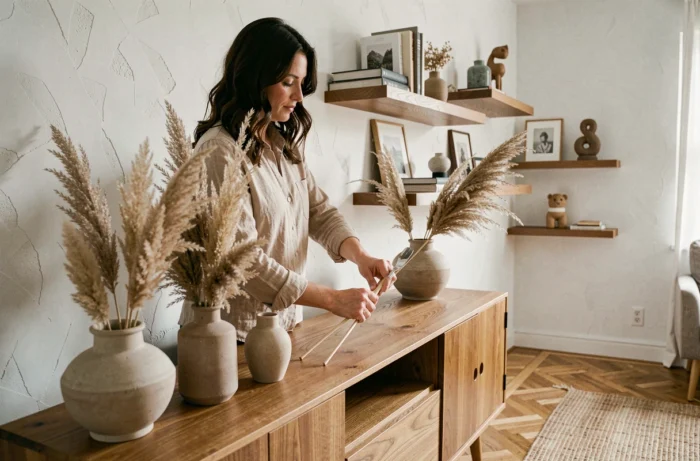
Creative Ideas and Tips to Enhance Your Interior Decor Daily
Enhancing an interior decoration goes beyond just choosing a nice sofa or a trendy color for the walls. The materials that make up your furniture, textiles, and coverings influence the air quality you breathe, the durability of your setup, and ultimately, your daily comfort. What concrete criteria help distinguish a sustainable decorative choice from a purely aesthetic purchase?
VOC Emissions and Interior Decoration: What the Air Label Reveals
Online competitors extensively detail color palettes and the interplay of textures. They overlook a measurable parameter: the volatile organic compounds emitted by decorative products.
In France, construction and decoration products have carried an indoor air emissions label rated from A+ to C since 2013. This scale covers paints, varnishes, adhesives, and floor coverings. However, particle board furniture, certain cushioning foams, and synthetic textiles do not always have an equivalent system.
The most beneficial creative idea for your health remains to check this label before any purchase of paint or wall covering, and to air out new furniture for several days before installing it in the living space. Solid wood furniture or a sofa with foams certified to limit emissions offers a double advantage: healthier indoor air and often a longer lifespan.
To explore decor inspirations that incorporate this type of concern, a useful resource is: https://elle-imagine.com/, which offers creative approaches that reconcile aesthetics and thoughtful material choices.
New, Second-Hand, or Upcycling Decoration: Comparing Options
Before embarking on a decor project, the question of sourcing deserves to be asked. Buying new, hunting for second-hand items, or transforming an existing piece do not yield the same results in terms of aesthetics, economy, and environment.
| Criterion | New Purchase | Second-Hand | Upcycling (Transformation) |
|---|---|---|---|
| Average Cost | Highest | Significantly Lower | Variable (materials + time) |
| VOC Emissions | Potentially High (panels, adhesives) | Low (off-gassing already done) | Depends on finishing products used |
| Uniqueness of Result | Standard (mass production) | Unique pieces, sometimes dated | Unique and customized piece |
| Waste Impact | Generates a replacement over time | Extends the lifespan of an object | Avoids disposal |
| Availability | Immediate | Random (limited stock) | Lead time for realization |
Reuse remains a minority in the overall treatment of household objects. The majority of end-of-life furniture still ends up in landfills rather than in resale or transformation circuits. Prioritizing the repair or customization of an existing sideboard before buying a new piece constitutes a decorative gesture in its own right, not just a compromise.
Upholstery Textiles and PFAS: A Health Criterion in Decoration
Cushions, curtains, throws, sofa covers: textiles represent the most accessible lever to refresh the ambiance of a living room or bedroom. Their health dimension is less known.
Some upholstery textiles treated for stain resistance or waterproofing contain PFAS, these per- and polyfluoroalkyl substances nicknamed “forever chemicals” due to their persistence in the environment.
For your daily decoration choices, this translates into a concrete selection criterion:
- Fabrics made from linen, raw cotton, or untreated wool offer natural resistance to light stains without resorting to PFAS, while adding warm textures to the decor.
- Textile labels certifying the absence of harmful substances allow for filtering products before purchase. Check for the presence of a recognized certification on the label.
- A throw made from recycled wool or a hemp cushion adds a unique touch to the living room while limiting exposure to these compounds.
Choosing untreated natural textiles protects air quality as much as it enriches the decorative palette. While synthetic waterproof velvet may have an appealing visual effect, its long-term health impact raises questions.

Decoration Trends 2025: Curves, Wood, and Statement Pieces in the Living Room
The guiding principles emerging from current interior decoration trends converge towards a few measurable axes.
The return of curves and noble materials like walnut marks a shift from straight lines and lacquered finishes that dominated in recent years. Furniture with rounded shapes, inspired by the 1970s, creates a cozy atmosphere in the living room or bedroom.
Conversely, the trend towards statement pieces (a sculptural armchair, a stone coffee table) replaces the logic of a coordinated total look. The idea is to concentrate the decor budget on one or two remarkable elements rather than renewing the entire furniture.
This approach aligns with the logic of reuse: a quality vintage piece integrated into a modern decor creates more impact than a generic new set. An Art Deco sideboard that has been sanded and waxed, placed in a room with light walls, becomes the centerpiece of the room without any additional purchase.
Sustainable Interior Decoration: The Important Trade-offs
Arranging your interior creatively requires prioritizing your choices. Here are the trade-offs that produce the most effect, both visually and practically:
- Invest in a paint rated A+ in emissions rather than a decorative paint without a label, even if there is a price difference.
- Allocate the main budget to a statement light fixture or piece of furniture, and complement it with second-hand or transformed accessories.
- Prioritize textiles labeled as PFAS-free for the living spaces where you spend the most time (living room, bedroom).
- Test the layout of a space before buying: move the sofa, swap two pieces of furniture, observe the result for a week.
Interior decoration gains coherence when each choice meets both an aesthetic goal and a verifiable quality criterion. A well-aging interior is one composed of healthy materials, meaningful pieces, and a layout tested daily, not simply copied from a catalog.