
Texts for My Son: Touching Ideas for Letters and Inspirational Messages
Writing to your son, whether it’s on a card slipped into a bag or in a long message sent from afar, engages in an act of communication whose effects go beyond the simple affectionate gesture. Letters and messages addressed to a child or teenager serve a specific function: to put words to a bond, to mark a moment, and sometimes to repair a silence.
Their form, length, and tone deserve attention that goes beyond the emotional impulse of the moment.
Adapting the message to the son’s age so that it is truly received
A text intended for a six-year-old child and a message addressed to a teenager do not work in the same way. Recommendations in parental communication clearly distinguish these two audiences. For a young child, naming and validating the felt emotion remains the priority: short sentences, concrete vocabulary, references to shared moments that he can locate in his memory.
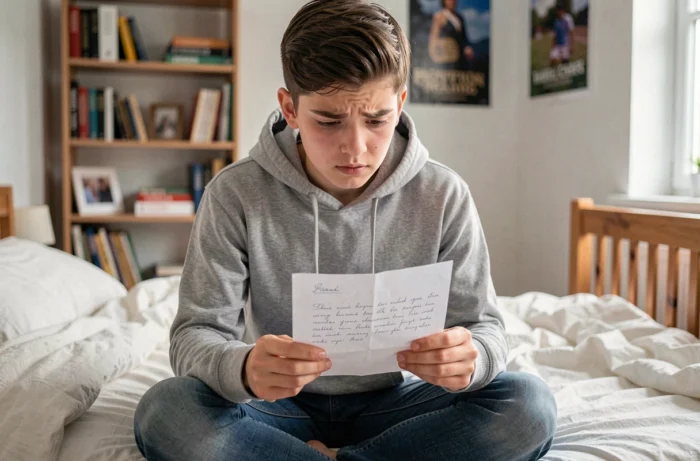
The teenager, on the other hand, needs a more horizontal exchange. He expects to be treated as a conversational partner, not as a passive recipient of parental discourse. A letter addressed to him benefits from including a form of participation, an open question, or simply the acknowledgment of his ability to think for himself.
Writing texts for my son therefore requires constant adjustment. The same parent, writing to the same child a few years apart, should produce messages that are significantly different in their structure and vocabulary.
- For a child under eight years old: sentences of five to ten words, references to tactile or sensory memories (a game, a meal, a trip), direct expression of affection without abstract metaphor.
- For a pre-teen: a slightly more conspiratorial tone, the possibility of mentioning topics he is discovering (friendships, first responsibilities), space left for humor.
- For a teenager or young adult: respect for his space, absence of guilt if the message goes unanswered, acknowledgment of his autonomy, phrasing that demands nothing in return.
Regular letters or a unique message: what frequency changes
The temptation is strong to concentrate all one’s emotion into a single long text, often written on the occasion of a birthday or a significant event. This approach has its limits. In the context of supporting placed children, for example, professionals recommend short and regular messages rather than a long exceptional letter.
The main argument lies in re-reading. A short message can be re-read by the child at his own pace, without the emotional burden that a dense text of several pages represents. It also does not require an immediate response, which reduces pressure on the recipient.
This logic applies well beyond separation situations. A parent who writes regularly to his son, even just a few lines, builds a continuous thread. Each message becomes a marker in time. Regularity creates a silent ritual, whereas a unique letter risks dramatizing a moment.
The case of long-distance relationships
When a parent lives far from his son (business trips, shared custody, expatriation), writing partially replaces physical presence. A message sent in the morning before school or a note left in a suitcase has a significance that video calls do not always cover. The text remains. It can be found months or years later, with a meaning sometimes different from the moment it was written.
Writing a text for your son without falling into generic language
The majority of letter templates available online follow the same pattern: unconditional love declaration, parental pride, wishes for happiness. These texts serve their function as a starting point, but they remain interchangeable. Any parent could sign them for any child.
A message that resonates almost always starts from a concrete detail. A habit the child has had since he was little. A phrase he uttered one day that stuck. An ordinary moment (a car ride, a rainy evening) that, in retrospect, took on a special dimension.
The symmetrical trap is wanting to say everything in a single text. Accumulating the qualities of your son, significant memories, and future projections ends up diluting each element. It’s better to choose a single angle, a single memory, and develop it with precision.
Examples of concrete triggers for a letter
- An object that the son has had since childhood and that the parent can recount the story of its acquisition.
- A recent situation where the parent observed a character trait in his son that he had not noticed before.
- A moment of difficulty experienced together, without embellishment, simply acknowledging that this passage mattered.
- A question that the parent genuinely has about the future of their relationship, phrased without demanding an answer.

When silence follows the message: accepting the absence of response
Sending a message to your teenage or adult son and receiving no reply can generate worry or frustration. Available data on communication with teenagers indicate that the absence of a response does not automatically mean rejection. Accepting silences and temporary refusals of dialogue can, on the contrary, preserve a space for voluntary return.
An inspiring or moving text benefits from ending without an injunction. No “reply when you can,” no “I’m waiting to hear from you.” The door remains open, but the son decides for himself when to cross it.
This posture requires a real effort. It implies writing to give, without expecting immediate reciprocity. The message then becomes a unilateral gift that gains its value over time, sometimes long after it was sent. Some sons re-read a text received in adolescence years later, with a perspective completely transformed by their own experience as a parent or adult.
Writing to your son remains a simple gesture in its form, but its effects depend as much on the content as on the context in which it arrives. A message adjusted to the age, rooted in a specific memory, sent without pressure for a response, is more likely to endure than the most beautiful declaration copied from a template.