
Discover the infinity symbol and its meaning throughout history and mathematics
The symbol ∞, this closed curve in the shape of a sideways eight, appears on jewelry, tattoos, and mathematics textbooks. Its outline seems familiar, almost mundane. Yet, the way it functions in mathematics differs radically from what popular culture attributes to it. Comparing its uses across disciplines allows us to measure the gap between the symbol as it is understood and the symbol as it operates.
Lemniscate and Unicode point: the symbol ∞ between typography and digital standard
Even before discussing mathematics or philosophy, the sign ∞ raises a technical question. How does a glyph that is centuries old survive in a global digital ecosystem?
The answer lies in a code: U+221E, named “INFINITY” in the Unicode standard. This code point, present since Unicode version 1.1, ensures consistent display on the Web, in mobile applications, and in composition systems like LaTeX or MathML. The entry was revised in the Unicode database 15.1, published in September 2023.
This standardization has a direct consequence: the symbol ∞ that you read here is strictly identical, byte for byte, to the one displayed on a phone in Tokyo or a browser in São Paulo. No other historical mathematical symbol has experienced such widespread use without losing its original form.
To delve deeper into the symbol of infinity and its meaning, we must go back to the English mathematician John Wallis, who introduced this notation in 1655. The geometric name of this curve, the lemniscate, comes from the Latin lemniscatus (“ornamented with ribbons”). Wallis never explained why he chose this specific shape, which has fueled centuries of speculation.
Infinity symbol in mathematics: a point, not a number
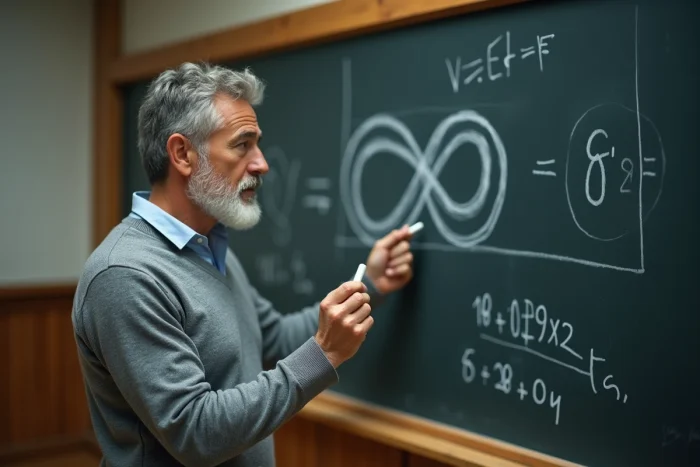
The majority of popular content presents ∞ as “a very large number.” This is a fundamental error. In modern analysis, ∞ is not a real number but a point added to compact a space. Terence Tao, in the third edition of his book Analysis I (2021 revision), dedicates a chapter to the “completed real line” and specifies that classical algebraic rules do not apply to ∞.
In practical terms, this means that operations like ∞ – ∞ or ∞ / ∞ do not have a defined result. One does not “calculate” with ∞ in the same way as with an integer or a real number.
Two contexts, two distinct infinities
| Context | Role of ∞ | Can we calculate with it? |
|---|---|---|
| Completed real line (analysis) | Point added at the ends of ℝ to make the space compact | Partially (restricted rules) |
| Riemann sphere (complex analysis) | Unique point added to ℂ to compactify the complex plane | No in the classical algebraic sense |
| Set theory (Cantor) | Infinite cardinals and ordinals, hierarchy of “sizes” of infinity | Yes, with its own arithmetic |
Georg Cantor demonstrated that there are multiple sizes of infinity. The set of integers and the set of real numbers are both infinite, but the infinity of the reals is strictly greater than that of the integers. This discovery caused a crisis in the foundations of mathematics at the end of the 19th century.
Philosophical infinity and mathematical infinity: opposing trajectories
The ancient Greeks were wary of infinity. Aristotle distinguished between “potential” infinity (a process that never stops, like the sequence of numbers) and “actual” infinity (a truly existing infinite totality). He rejected the latter. This distinction dominated Western thought for nearly two millennia.
In contrast, medieval theology rehabilitated actual infinity by associating it with God. Infinity became an attribute of the divine, an absolute perfection, completely reversing the Aristotelian judgment.
Diverging meanings across disciplines
- In modern mathematics, infinity is a technical tool with precise rules, devoid of any moral or spiritual connotation. It is used to describe limits, convergent series, and topological spaces.
- In philosophy and spirituality, the symbol ∞ evokes eternity, the balance between two forces, the perpetual cycle of life. These associations have no connection to the mathematical definition.
- In contemporary culture (jewelry, tattoos, design), the sideways eight functions as an ideogram of eternal love or harmony, a meaning constructed by use, not by mathematics.
The gap between these registers is rarely articulated clearly. The same glyph ∞ designates concepts that have almost nothing in common depending on whether one opens an analysis textbook or a jewelry catalog.

Wallis, Cantor, Unicode: three dates that structure the history of the sign ∞
Three moments concentrate the essence of the evolution of this symbol. In 1655, John Wallis fixed the graphic form in his work De sectionibus conicis. For more than two centuries, the sign remained confined to mathematics treatises.
At the end of the 19th century, Georg Cantor transformed the very nature of the concept by demonstrating that infinity is not monolithic. His set theory introduced a hierarchy of infinite cardinals, each “larger” than the previous one. Infinity ceases to be a unique concept and becomes a family of concepts.
The third stage is digital. The integration into the Unicode standard has allowed the symbol to circulate in all digital writing systems without alteration. This transition from paper to computer code has amplified the cultural dissemination of the sign, far beyond its original mathematical use.
The symbol ∞ remains a singular case in the history of notations: a sign whose form has not changed since the 17th century, but whose meaning has fragmented into incompatible branches. The mathematician sees it as a formal tool, the philosopher as an open question about the nature of the universe, the designer as a decorative motif. This fragmentation is not a flaw. It confirms that the power of a symbol is measured by the number of interpretations it can support without breaking.