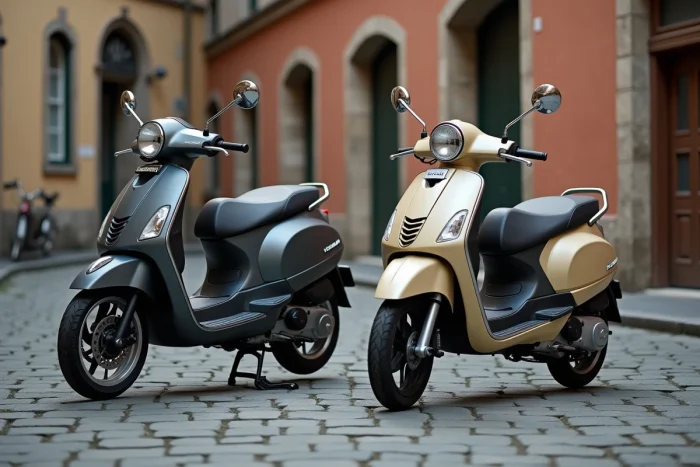
Comparison of 49cc and 50cc Motorcycles: Understanding the Differences Before Choosing
The distinction between 49cc and 50cc fuels ongoing debates on forums and in dealerships. In reality, this difference in engine displacement is more about commercial technical specifications than a true mechanical gap. What separates two mopeds in 2026 is their regulatory compliance, engine architecture, and electronic management, not a cubic centimeter more or less.
Actual displacement and machining tolerance on moped engines
A 49cc engine and a 50cc engine often come off the same production line. The nominal displacement depends on the bore and stroke dimensions, and industrial machining tolerances create a gap that is measured in fractions of a cubic centimeter.
Regulation (EU) No. 168/2013, which governs the approval of L-category vehicles, sets the limit at 50 cm³ for thermal mopeds. A manufacturer that lists 49.5 cm³ on its product sheet allows itself a safety margin relative to this regulatory ceiling. Another that displays 49.9 cm³ makes the same calculation with less caution.
We observe that this comparison of 49cc and 50cc bikes generates confusion because buyers read heterogeneous technical sheets without understanding that the displayed value is rounded, never exact to the nearest tenth. A horizontal Minarelli engine and a Derbi Euro engine differ much more in their architecture than in their nominal displacement.
Euro standards and electronic injection: the real technical divide of 50cc
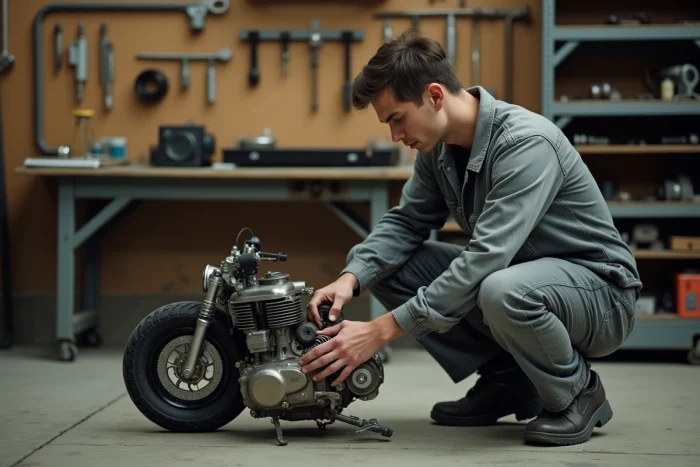
The 49cc versus 50cc debate masks a more structuring technical subject: compliance with anti-pollution standards profoundly transforms small thermal engines. Mopeds sold in Europe must meet the emission requirements defined by Regulation (EU) No. 168/2013, which has forced the abandonment of carburetors in favor of electronic injection on almost all new models.
This migration has direct consequences on engine behavior. Injection manages the air-fuel mixture with a precision that carburetors cannot achieve, improving low-speed operation consistency and reducing consumption.
On the other hand, maintenance changes in nature. For a carburetor, cleaning and adjusting the jet were sufficient. On an injected system, diagnostics require an electronic tool, and replacing an injector or sensor costs more than a complete carburetor kit. Maintaining a 50cc injected engine requires electronic diagnostic tools.
Catalytic converter and perceived performance
The addition of a catalytic converter in the exhaust line generates additional back pressure. On a small displacement engine, this back pressure is felt more than on a larger displacement block. Some owners perceive a loss of responsiveness compared to older generation models, fueling nostalgia for “real” carbureted 50cc.
We recommend not to confuse this perceived loss of liveliness with an engine defect. It results from a compromise imposed by regulation, and it affects models displaying either 49cc or 50cc on their registration documents.
Category L1e and homologation: what the road code really says
Article R311-1 of the French Road Code defines a moped as a motor vehicle with two or three wheels whose engine displacement does not exceed 50 cm³ for thermal engines, or whose maximum power does not exceed 4 kW for electric motors. The maximum speed by construction is limited.
This definition has a direct consequence: a thermal vehicle of 51 cm³ falls out of the moped category and shifts into a higher category, with different obligations regarding licenses and insurance. A 49 cm³ vehicle and a 50 cm³ vehicle both remain in the same L1e category.
- The AM license (formerly BSR) is sufficient to drive any L1e category moped, whether the sheet indicates 49 or 50 cm³
- Insurance does not distinguish between the two displacements: the premium depends on the model, the age of the driver, and the geographical area, not on a cubic centimeter difference
- The technical inspection, now applicable to motorized two-wheelers, focuses on emissions and mechanical condition, without differentiating the subcategories of displacement within the L1e class

50cc thermal or electric equivalent: the real displacement question in 2026
Rather than comparing 49 and 50 cm³, we believe the relevant choice lies between thermal and electric. Electric models in the L1e category (equivalent to 50cc) are multiplying, with brands like Niu, Super Soco, or VMoto offering scooters and lightweight motorcycles positioned in this segment.
An electric equivalent to 50cc is defined by its power in watts, not by a displacement. The regulatory limit of 4 kW determines the classification as a moped. This power ceiling replaces the notion of displacement and simplifies the reading grid for the buyer.
Usage cost and battery range
The usage cost of an electric equivalent to 50cc focuses on the battery. Its capacity, expressed in watt-hours, determines the range and represents the most expensive replacement item over the vehicle’s lifespan. For a thermal vehicle, the main cost remains fuel consumption and engine maintenance (oil change, spark plug, filter).
Electric models like the Masai Vision or the Easy ranges from certain manufacturers target daily urban use with removable batteries rechargeable from a household outlet. The range varies according to battery capacity and driving profile, but it remains suitable for short trips.
The difference between 49cc and 50cc has never represented a significant mechanical or regulatory choice criterion. What matters is the vehicle’s compliance with its homologation category, the quality of its injection system or electric motorization, and the match between the intended use and the model’s characteristics. A buyer who hesitates between two technical sheets displaying different displacements by a cubic centimeter is wasting their time on a false problem.