Everything You Need to Know About the Legality of Tear Gas Sold at Decathlon
In France, tear gas and defense sprays are classified as category D weapons under the Internal Security Code. This classification allows their purchase and possession by adults without prior declaration, but strictly regulates their carrying, transport, and use. Decathlon, like any retailer distributing this type of product, applies this regulatory framework with additional requirements specific to its network.
Chemical Regulation of Tear Gas Sprays: Beyond Category D
Most content on the subject only mentions the category D of the Internal Security Code. This classification defines the conditions for acquisition and possession, but it does not cover all the obligations that apply to a spray sold in stores.
Decathlon has integrated the constraints of the EU CLP Regulation (classification and labeling of chemical products) as well as the developments of the REACH regulation concerning certain solvents and propellant gases. In practice, this has led the brand to reformulate or delist several models of sprays whose components no longer met European regulatory thresholds.
Every spray sold in stores must be accompanied by a compliant safety data sheet (SDS). These sheets detail the chemical composition, exposure risks, and first aid measures. A spray based on CS gas (orthochlorobenzylidene malonitrile) and a pepper spray (capsaicin, or OC) do not have the same SDS or labeling pictograms.
To delve deeper into the conditions of purchase and possession in stores, the legal guide to Decathlon’s tear gas canisters details the checks to which each buyer is subject.
Decathlon Sales Protocol: A Stricter Filter than the Law
Since 2023, Decathlon has imposed an internal questioning protocol on its sellers regarding usage. This safety brief, disseminated throughout the France network, stipulates to refuse the sale in cases where statements suggest an offensive use or use in demonstrations, even when the transaction would be legally possible.
This filtering goes beyond legal obligations. The law only requires verification of the buyer’s majority for category D weapons sold freely. Decathlon adds a layer of behavioral assessment that falls under its internal responsibility policy.
Responses from ministers to written questions from deputies, published in the Official Journal between 2023 and 2024, have addressed the sale of category D weapons around sporting events. These exchanges confirm that sports retailers have discretion to restrict sales beyond the minimal legal framework.
Category D: Conditions for Carrying and Transporting a Defense Spray
Category D includes weapons subject to registration and those sold freely. Tear gas sprays with a capacity of 100 ml or less fall under sub-category D2, accessible without administrative formalities to adults.
The carrying of these sprays in public remains authorized, but the legitimate reason of self-defense conditions the legality of their use. Carrying a spray in one’s bag does not in itself constitute an offense. Using it disproportionately or without a real threat exposes one to criminal prosecution.
- Purchase is free for any adult, without declaration or permit.
- Transport must be done under reasonable conditions (bag, pocket), without ostentation.
- Use is only covered by legitimate defense if it responds to an actual or imminent aggression, with proportionality between the threat and the response.
- Sale to a minor is prohibited, even with parental consent.
CS Gas, Pepper Gel, or Mixed Spray: Impact of Choice on Legality
Not all sprays sold at Decathlon contain the same active substance. This distinction has practical and legal implications that buyers often underestimate.
The CS gas causes intense but brief eye and respiratory irritation. It disperses in the air, making it less precise in windy outdoor conditions and more problematic in confined spaces (risk of collateral exposure).
The pepper gel (OC) projects a concentrated jet that adheres to the assailant’s skin. Its range is generally shorter, but the risk of contaminating bystanders is reduced. In the event of use in self-defense, this characteristic can work in favor of the user during the proportionality assessment by a court.
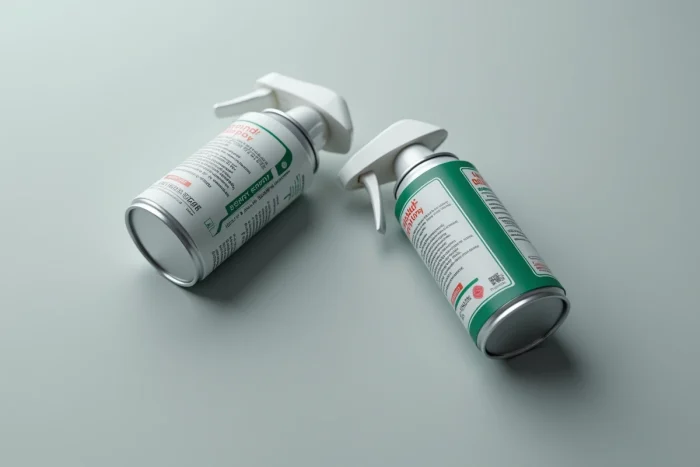
Some models combine both agents. The classification remains the same (category D2), but the SDS are more complex and the storage conditions more stringent. An expired or poorly stored mixed spray can lose effectiveness while remaining chemically dangerous.
Criminal Penalties for Misuse of a Tear Gas Canister
Using a tear gas spray outside the framework of legitimate defense transforms a defensive object into an offensive weapon. Penalties vary depending on the severity of the injuries caused and the context.
- Use without a real threat constitutes willful violence with a weapon, an aggravating circumstance under the Penal Code.
- Use in a group (demonstration, gathering) further aggravates the legal qualification.
- Possession by a minor, even without use, exposes the seller and the minor to separate prosecutions.
Having purchased the spray legally at Decathlon or elsewhere does not change the legal qualification of its use. The legality of acquisition never covers disproportionate use.
The line between defense and aggression often hinges on factual details: distance from the assailant, duration of spraying, prior attempt to flee. Keeping the receipt and product instructions can facilitate the demonstration of good faith, without guaranteeing acquittal.