At what age does a baby start opening doors and how to support them?
The ability of a toddler to open a door depends less on their chronological age than on the type of handle installed in your home. A lever handle is manipulated much earlier than a round handle because the motor skills involved are not the same. Understanding this distinction changes the way we secure the home and how we support the child in this new conquest of autonomy.
Lever handle or round handle: two very different motor actions
Research on fine motor skills published in 2022 (Rodrigues et al., Developmental Medicine & Child Neurology) shows that the grip strength and forearm supination required to turn a standard round handle are acquired several months after the ability to lower a lever. In practice, many children operate a lever handle before the age of two, while they can only correctly turn a round handle after two and a half years.
The lever only requires a downward push, which can be done with the palm or forearm. The round handle demands controlled wrist rotation combined with a firm grip, a movement that requires much finer coordination between the muscles of the hand and forearm.
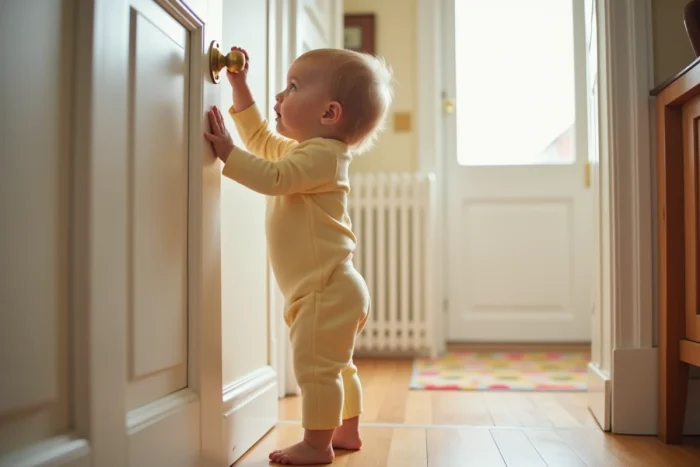
The age at which a baby opens doors therefore varies significantly from one household to another depending on the equipment. An 18-month-old child living in an apartment with lever handles may surprise their parents much earlier than one growing up in an old house with round porcelain handles.
Fine motor skills and grip: the concrete prerequisites for operating a door
Before focusing on the door itself, it is essential to observe where the child stands in mastering everyday objects. Grip develops in stages, and each stage enables a new type of manipulation.
- The palmar grip (grasping an object with the whole hand) appears early, often before the age of one. It is sufficient to lower a large lever if the child is tall enough to reach it.
- The pincer grip (thumb-index) solidifies between 12 and 18 months. It allows for turning small objects, but not yet for maintaining a rotational pressure on a round handle.
- Controlled forearm supination, which allows for turning a key or a handle, gradually develops between 18 and 30 months depending on the child.
A child who unscrews the cap of a plastic bottle or turns the pages of a board book one by one shows that they are progressing towards the wrist rotation necessary for a round handle. These everyday actions are good indicators.
Size and height matter as much as dexterity
A detail often overlooked: even with the required motor skills, the child must be able to reach the handle. The standard height of a door handle in France is around one meter. An 18-month-old child is on average significantly shorter than that. They sometimes compensate by standing on tiptoes, using a step stool, or pulling an object in front of the door.
Physical access to the handle is the first limiting factor, even before the question of fine motor skills. When a child starts moving objects to climb on top, securing the area becomes urgent, even if they have not yet succeeded in opening a door.
Home safety: why anticipate rather than react
The 2023 report from the Royal Society for the Prevention of Accidents (RoSPA) in the UK indicates an increase in injuries related to what emergency responders call “quiet wandering”: a toddler leaves a room or the home without the adult realizing it. This phenomenon begins as soon as the child walks steadily, sometimes well before they can actually open a door (a poorly closed or ajar door is enough).
Several European countries have strengthened their official recommendations since 2023: install door stoppers or secure handles as soon as the child moves independently, without waiting for them to demonstrate their ability to open. The American Academy of Pediatrics adopts the same preventive logic.
Which device to choose according to the type of door
- For lever doors: plastic handle covers that prevent the child from lowering the mechanism. They can be easily removed by an adult but resist the force of a child under three years old.
- For round handle doors: the risk is later, but a door stop at the top of the door frame remains useful for dangerous areas (kitchen, garage, basement stairs).
- For sliding doors or patio doors: rail locks prevent opening beyond a few centimeters.
Door stoppers do not replace supervision, but they provide a reaction time. In a home where all doors are equipped with levers, the window between “the child walks” and “the child opens doors” can be very short.
Supporting the child without hindering their autonomy
Blocking all doors permanently poses another problem: the child does not learn to manage this action or to understand the spatial limits of the home. The available data does not allow for a definitive conclusion between a strictly restrictive approach and a gradual approach, but pediatric ergonomists generally recommend a compromise.
Leaving one or two “allowed” doors (child’s room, playroom) without a safety device allows the child to practice in a controlled environment. Doors leading to risky areas remain locked. This approach respects the need for exploration while limiting dangerous scenarios.
Naming spaces and rules helps the child integrate boundaries long before they can understand them verbally. “You can open this door. That one is a no.” Daily repetition, associated with the action, eventually becomes ingrained, usually between the ages of two and three.
The question of opening doors is not just a simple motor milestone to check off on a development grid. It lies at the intersection of fine motor skills, the child’s morphology, and the layout of the home. Adapting the environment at the right moment, that is, before the first successful attempt, remains the most widely shared recommendation by accident prevention organizations.