
How to Choose the Ideal Tulle to Enhance Your Wedding Dress?
The tulle used for a wedding dress is not a unique fabric. Behind this term lie very different compositions, weights, and mechanical behaviors depending on the fiber used. Comparing these variants based on measurable criteria allows for the selection of a tulle suitable for the cut of the dress, the climate on the big day, and the expected duration of wear.
Nylon, polyester, or bio-sourced polyamide tulle: compared properties
Most commercially available wedding dresses use nylon or polyester tulle. These two synthetic fibers dominate the market, but they do not react the same way to humidity, body heat, and repeated friction.
| Criterion | Nylon tulle | Polyester tulle | Bio-sourced polyamide tulle |
|---|---|---|---|
| Breathability | Average | Low to average | Superior (tested by IFTH) |
| Moisture resistance | Deforms faster | Better water resistance | Slower degradation in humid conditions |
| Touch | Soft, slightly slippery | Stiffer, slight rustling | Soft, similar to nylon |
| Relative cost | Entry-level to mid-range | Entry-level | Higher |
| Use in humid climate | Not recommended | Acceptable | Recommended (IFTH data) |
The French Institute of Textile and Clothing (IFTH) compared these fibers in a study published in November 2025. Bio-sourced polyamide tulle offers better breathability and is more resistant to degradation in humid conditions. For an outdoor wedding or in a warm climate, this information is a game changer.
To learn more on Info Mariage, the tulle variants are detailed with their specific uses according to the type of dress.
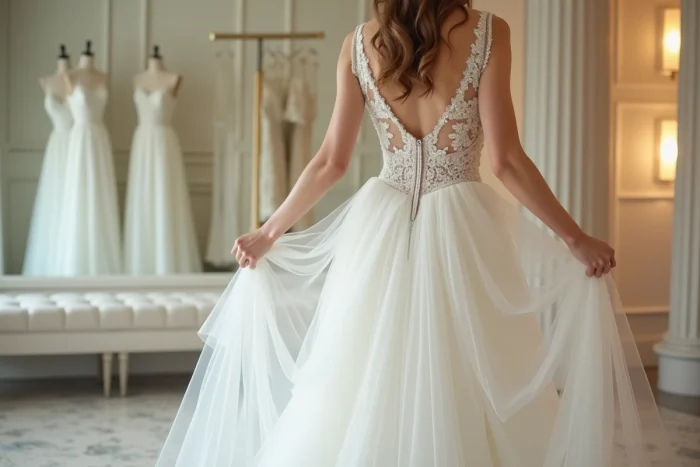
Soft tulle or rigid tulle: what impact on the bride’s silhouette
The choice between soft tulle and rigid tulle determines the volume and drape of the skirt. It is not just a matter of personal taste; it is a technical parameter related to the cut.
Soft tulle for fluid cuts
Soft tulle hugs the curves without adding volume. It is suitable for mermaid-style dresses or flared skirts that need to fall naturally. Soft tulle creates an airy drape without stiffening the silhouette. Multiple layers of soft tulle produce a translucent depth effect, particularly suited for bohemian dresses or long veils.
Rigid tulle for voluminous skirts
Rigid tulle maintains the structure of a princess skirt or petticoat. It serves as architectural support for the dress. Without rigid tulle, a voluminous skirt collapses within a few hours of wear.
Combining both in the same dress is common. Designers use rigid tulle as an underlayer for support and soft tulle on the surface for a gentle touch and visual appeal.
Durability of tulle in real wedding conditions
A rarely discussed point in selection guides concerns the durability of tulle over the actual duration of a wedding. A wedding dress is typically worn for an entire day, with varied movements (walking, dancing, prolonged sitting).
- Entry-level tulles show visible signs of wear (snags, deformations) after several hours of intensive wear, especially during prolonged dancing, according to a survey by Brides.co
- Mid-quality tulles (dense nylon or high-tenacity polyester) resist friction better but may retain heat
- The stretch tulle offers superior freedom of movement, but its more open mesh makes it more vulnerable to snags on rough surfaces (reception furniture, jewelry)
Longevity is not just a matter of fiber. The weight of the tulle, the mesh density, and the quality of the finishes (hems, reinforcement seams) play a role at least equal to the composition.
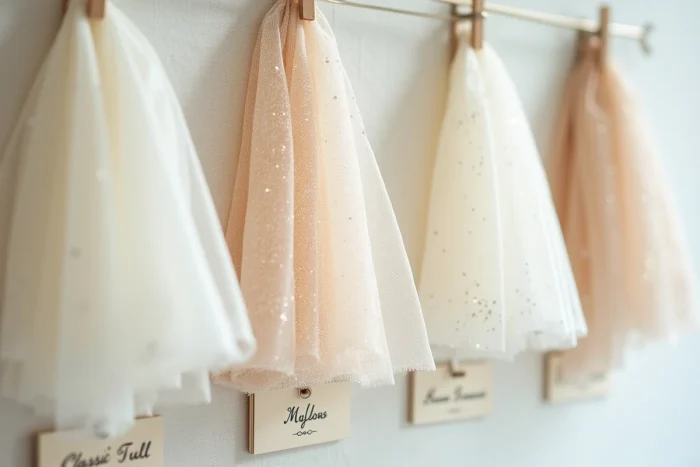
Recycled and eco-friendly tulle: a credible option for a wedding dress
Recycled tulle is gaining ground in wedding dress collections. According to The Knot’s “Wedding Industry Sustainability Trends 2025” report, certified models using recycled materials have seen a significant increase since 2024. This trend responds to a growing demand for sustainability from future brides.
Recycled tulle is made from recovered synthetic fibers (fishing nets, textile production scraps). Its touch and drape are now close to that of classic tulles, to the point that the difference is difficult to perceive visually.
Fire safety standards for synthetic tulles
EU Regulation 2025/1234, which came into effect in March 2025, imposes mandatory fire retardant treatments for synthetic tulles used in ceremonial clothing. Not all suppliers fully comply yet. Checking the tulle’s compliance with this standard before purchase is a useful reflex, especially for dresses ordered outside the European Union.
Criteria for choosing tulle according to the style of wedding dress
Simplifying the choice of tulle to a single variable (soft or rigid, natural or synthetic) would be reductive. Several criteria must be considered together.
- The cut of the dress: a princess skirt requires rigid tulle as an underlayer, a fluid dress calls for soft tulle on the surface
- The climate and location of the ceremony: an outdoor wedding in high heat points towards breathable tulle (bio-sourced polyamide or silk tulle)
- The expected duration of wear: for a reception that extends into the night, prioritize dense tulle resistant to snags
- The desired texture: silk tulle offers a softer touch than nylon tulle, but at a significantly higher cost
- Environmental beliefs: certified recycled tulle is a viable alternative without visible compromise on appearance
The choice of tulle for a wedding dress is based on a balance between the desired silhouette, the real conditions of the big day, and the mechanical resistance of the fabric. The IFTH data on breathability and field feedback on durability point towards more technical fibers than entry-level nylon. Cross-referencing the cut, climate, and duration of wear remains the best selection filter.