
How to Choose the Right Equipment for Electric Beds for Optimal Comfort
A relaxation bed delivered to a room on the first floor, a mattress that is too firm and refuses to follow the movements of the frame, a remote control with buttons that make no logical sense: we have all heard this type of feedback. Choosing an electric bed is not just about comparing prices. Comfort mainly depends on the compatibility between each component, from the bed base to the bedding.
Energy consumption of an electric bed: what the motor really costs
Before discussing comfort, let’s talk about connection. An electric bed operates on mains power, with one or more motors that operate the sleeping surfaces. Actual consumption depends on the number of motors and the frequency of daily use.
A model with two motors consumes significantly less than a model with four motors, simply because there are fewer moving mechanisms. With typical use (a few adjustments per day, not continuous medical use), the consumption remains very low compared to other household appliances. We are talking about a negligible impact on the annual bill in most households.
Eco-friendly alternatives are starting to appear: low-consumption motors, automatic standby systems that cut power after a period of inactivity. Some manufacturers now integrate more efficient transformers to limit losses in standby mode. If ecological considerations matter in your choice, check for the presence of an automatic shut-off function and the energy class of the transformer.
Mattress for relaxation bed: compatibility and materials
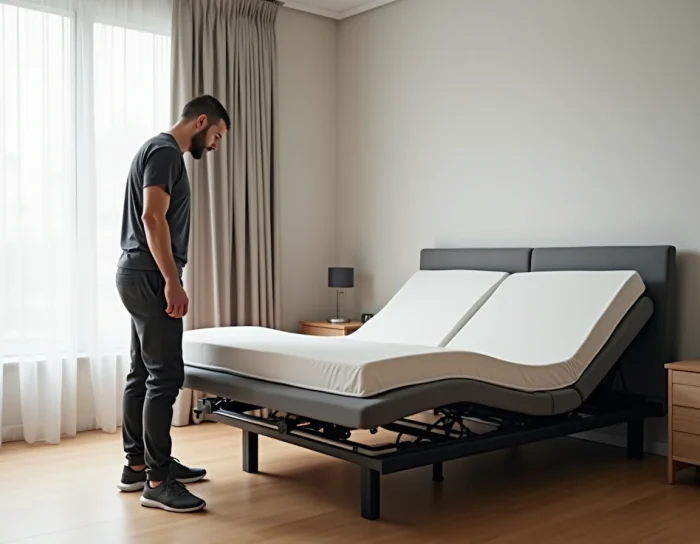
The most common trap is installing a standard mattress on an electric base. A traditional pocket spring mattress, for example, does not fold properly when the base raises the head or feet. The spring resists, the mattress deforms, and comfort disappears within weeks.
For a relaxation base, we look towards three families of compatible materials:
- Memory foam, which conforms to the movements of the frame without resistance and returns to its original shape. This is the most common choice for electric bed equipment intended for daily use.
- Natural or synthetic latex, which offers superior elasticity and good ventilation. It follows the joints of the base without creating permanent creases.
- High-resilience foam, a compromise between firmness and softness, suitable for those seeking a more supportive feel than memory foam.
A mattress that is too thick blocks the movements of the base. Beyond a certain thickness, flexibility decreases and the motors strain. Feedback on this point varies by brand, but it is noted that a mattress between 15 and 20 cm thick offers the best compromise between comfort and folding flexibility.
Slatted or modular base: the choice according to your morphology
Both technologies coexist in the market, and the choice depends less on budget than on your body type and any potential pain.
Multiplex beech slats
The slats provide linear, firm, and homogeneous support. They are suitable for average-sized individuals who do not have specific joint issues. The slatted base remains the standard for relaxation bedding, offering good value for money.
Multidirectional modules
The modules pivot individually in all directions. Each point of the body receives a response adapted to the pressure applied. For individuals suffering from back pain or circulation problems, the modules offer a morphological adaptation that slats cannot replicate. The price is higher, but the gain in sleep comfort is measurable from the first nights.
Hybrid models can also be found, with modules at the shoulder and hip level, and slats on the rest of the frame. This configuration targets the main pressure areas without burdening the overall budget.

Remote control and motorization: two or four motors
The motorization determines the number of positions the bed can adopt. A two-motor base manages two planes: the raising of the torso and that of the legs. A four-motor model adds independent adjustment for the head and feet, allowing for more precise intermediate positions.
In practice, two motors are sufficient for typical comfort use (reading, watching TV, relieving heavy legs). The four motors are justified when seeking fine therapeutic positions, such as anti-reflux or targeted elevation of the calves.
The wired remote control remains the most reliable. Wireless models offer more freedom of movement but require recharging or battery changes. Ensure that the buttons are identifiable by touch, especially for nighttime use. A backlit remote control avoids the need to turn on the light to adjust your position at three in the morning.
Back translation: a detail that changes everything
When the base raises the backrest, a back translation mechanism slides the back plane backward to avoid abdominal compression. Without this function, the body compresses and the digestive organs are squeezed with each elevation. This is a criterion rarely highlighted in product sheets, but it is crucial for real daily comfort.
Accessories and bedding suitable for electric bedding
A standard fitted sheet comes off as soon as the base moves. For a relaxation bed, deep-pocket fitted sheets or models specifically designed with reinforced elastics at all four corners are needed.
The mattress topper must also be sufficiently flexible to accompany the movements of the frame. A rigid or too thick topper negates the advantage of the modular base.
Some mainstream models now integrate automated anti-fall positions and motion sensors, functions once reserved for the hospital environment.
The choice of an electric bed relies on the coherent assembly of components that work together. A good base with a poor mattress, or a suitable mattress on an under-motorized frame, produces the same result: poor sleep. Test each combination in-store for at least ten minutes in a lying position, not just sitting on the edge of the bed.