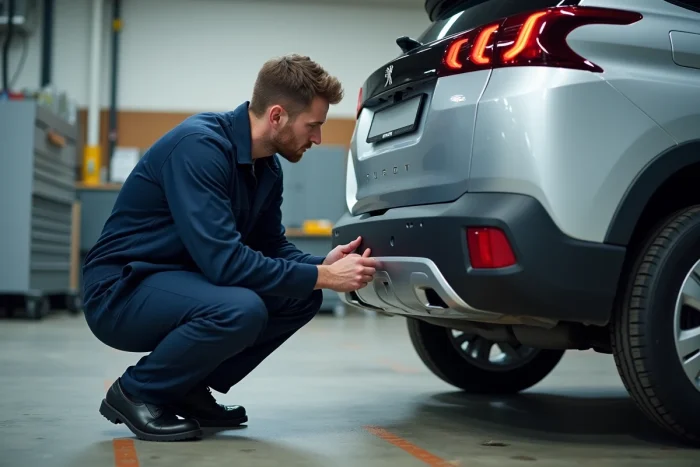
How to solve parking assistance issues on your Peugeot 3008?
The message “parking assistance failure” that appears on the dashboard of your Peugeot 3008 does not always mean that a sensor is dead. In many cases, the problem lies elsewhere: a software defect, moisture infiltration, or simple dirt buildup can trigger the alert. Understanding the actual source of the failure prevents unnecessary part replacements.
ADAS coupling and parking assistance on Peugeot 3008: a frequently overlooked avenue
Have you noticed that the error message appears at the same time as another warning, such as a collision alert or a malfunction of the 360° camera? This is not a coincidence.
On the 3008 II equipped with advanced options (video pack, 360° camera, Park Assist), the parking assistance system shares software resources with other driving aids. The camera control unit and the BSI (Body System Interface, the vehicle’s central electronic brain) communicate with each other. When there is a software incompatibility between modules, the parking system may display a fault even when the sensors are functioning perfectly.
The Peugeot network disseminates software update campaigns to correct these conflicts, but this information circulates little outside authorized workshops. An owner who goes to an independent garage risks being offered unnecessary sensor replacement due to lack of access to these service notes.
Before any hardware intervention, ask your dealer to check if a BSI control unit or camera module update is available for your vehicle. Several owners have found solutions for Peugeot 3008 parking assistance faults simply through this software step, without physical replacement.

Ultrasonic sensors of the 3008: check before replacing
Ultrasonic sensors remain the most common cause of failure. Located in the front and rear bumpers, they measure the distance between your vehicle and obstacles. Their failure causes the infamous continuous beep or a complete lack of signal.
The usual reflex is to change the faulty sensor. This is sometimes the right decision, but not always the first one to take.
Cleaning and visual inspection
Dirt, dried mud, or frost can block ultrasonic waves. A simple cleaning with warm water and a soft cloth resolves the issue in a significant number of cases. Also, check that the bumper paint does not cover a sensor after a bodywork touch-up: a layer that is too thick can distort measurements.
The mobile phone test
An accessible test allows you to determine if a sensor is still emitting. Place your phone in video recording mode just in front of each sensor, with the ignition on and reverse engaged. When you listen to the recording, you should hear a regular clicking sound (the famous “tick-tick-tick” of the ultrasound). If a sensor remains silent, it is likely defective.
Fuses to check first
Before ordering a replacement sensor, check two fuses:
- Fuse F12, related to the front sensor circuit, is located in the cabin fuse box.
- Fuse F35, associated with the rear sensors, is in the same box. A blown fuse cuts power to the entire circuit without damaging the sensors themselves.
- The reverse switch is also worth a look: if the reverse lights come on normally, the problem is not there. Otherwise, the system does not receive the reverse engagement information and remains silent.
Electronic diagnosis on Peugeot 3008: when the tool makes the difference
A multimeter is not sufficient to identify an intermittent fault in parking assistance. Random failures (message that appears and then disappears, sensor that works when cold but not when hot) point to a deeper electrical problem.
The PSA/Stellantis network uses the Diagbox tool to read fault codes specific to the parking system. This tool precisely identifies which sensor, harness, or control unit is at fault. An independent garage equipped with a generic scanner may detect an overall fault, but not always pinpoint the exact source.
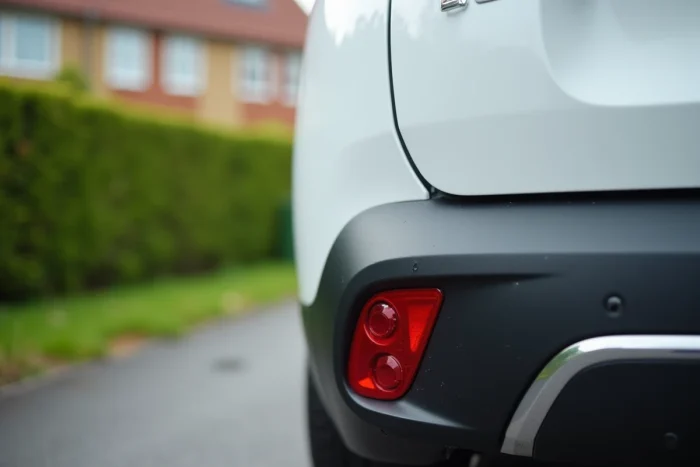
Moisture infiltration in the bumper connectors causes intermittent short circuits. After a collision, even a minor one (parking scrape, contact with a pole), the sensor mount may deform imperceptibly. A misaligned sensor by a few millimeters detects phantom obstacles or fails to detect anything at all. The bodywork networks partnered with Stellantis are aware of this phenomenon, but a quick visual check does not always reveal it.
Peugeot warranty and parking assistance: what you need to know
Coverage for a parking assistance fault under the manufacturer’s warranty is not automatic. If the vehicle is still covered, the dealer must first establish that the problem is due to a manufacturing defect or software flaw, and not from a collision or poor maintenance.
Owners who experience recurring failures despite repairs should keep every invoice and repair order. In case of refusal of coverage, Stellantis customer service can be contacted directly. Mediation is possible if dialogue with the dealer does not yield results.
For vehicles out of warranty, costs vary significantly depending on the source of the problem. Professional cleaning remains inexpensive. Replacing a single sensor represents a moderate expense. However, replacing the BSI control unit is the most expensive intervention, and it is only justified after a complete diagnosis.
A parking assistance fault on a Peugeot 3008 is rarely resolved by changing the first part that comes along. Start with cleaning, then the fuses, followed by the software update. Professional electronic diagnosis should be the last resort, but it often makes the difference when simple checks yield no results.