How to Identify and Treat the Main Diseases of Bay Laurel in the Garden
Bay laurel (Laurus nobilis) is a Mediterranean shrub known for its hardiness. Its aromatic leaves withstand most aggressions, but certain fungal diseases and pests cause visible damage that progresses quickly without intervention. Recognizing the early symptoms allows for action before the problem compromises the harvest or the vigor of the shrub.
Bay laurel in urban environments: when the heat island changes the game
Gardening guides treat bay laurel as a plant suited for temperate to Mediterranean climates, with recommendations tailored for an open garden. In the city, the reality is different. Concrete surfaces, reflective walls, and building density create microclimates where nighttime temperatures remain several degrees above those measured in the outskirts.
This excess heat extends the activity season of pests. The EPPO has documented a significant increase in infestations by Trioza alacris (the bay psyllid) in Southern Europe since 2023, linked to longer reproductive cycles favored by warming. In urban settings, this phenomenon is exacerbated: psyllids find favorable conditions earlier in spring and remain active later in autumn.
For a bay laurel grown on a balcony, in a courtyard, or along a south-facing wall, preventive treatments should start earlier than what traditional calendars recommend. Visual monitoring starting in mid-March, rather than in April, is relevant in these configurations. To delve deeper into the subject, a file dedicated to bay laurel disease on My Fish Book details the parasitic cycles according to environments.
Curling leaves of bay laurel: identifying the psyllid Trioza alacris
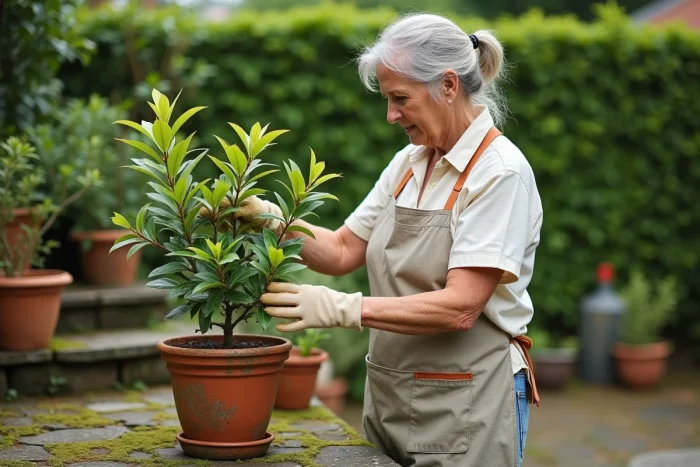
The most common symptom on bay laurel is the deformation of young leaves, which curl in on themselves and form thick galls, often yellowish or reddish. This is not a fungus. The culprit is Trioza alacris, a small piercing-sucking insect whose larvae develop inside the deformed leaves.
Recognizing a psyllid attack
The galls appear on the new shoots. When opening a curled leaf, one can observe tiny flattened larvae, translucent to greenish, surrounded by a sticky honeydew. Older leaves are generally not affected.
The honeydew secreted by the larvae in turn attracts sooty mold, a black, powdery fungus that covers the surface of the leaves. Sooty mold does not penetrate the tissues; it develops on the sugary deposit. Treating the psyllid eliminates the cause, and the sooty mold gradually disappears.
Suitable treatments since the ban on neonicotinoids
Since a ministerial decree on January 22, 2024, systemic insecticides based on neonicotinoids are no longer permitted on bay laurel in France. Alternatives are based on two axes:
- Natural predators, particularly lacewings and certain species of ladybugs, which consume psyllid larvae. Their introduction works mainly in greenhouses or on container-grown laurels, where the population remains localized.
- Sprays of diluted black soap or rapeseed oil, applied as soon as the first galls appear, suffocate the larvae without toxic residue. The application should be repeated after each rain.
- Targeted pruning of affected shoots, to be done before the larvae reach the winged adult stage, limits the spread to the rest of the shrub.
Black and brown spots on bay laurel leaves: fungal causes
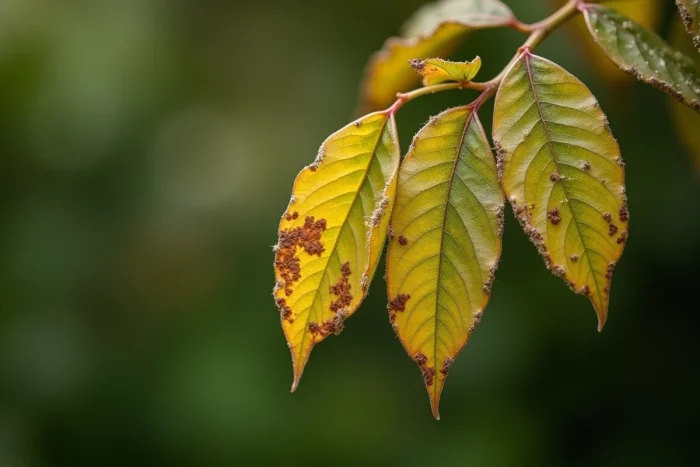
Brown to black circular spots, sometimes bordered by a yellow halo, indicate a fungal attack. Several fungi can be responsible, but the underlying mechanism is always linked to prolonged excess moisture on the foliage.
A bay laurel that is too confined or overwatered develops fungal spots more quickly than a well-ventilated specimen. The density of the persistent foliage prevents the rapid drying of leaves after rain or overhead watering.
Corrective measures
Removing affected leaves and collecting them from the ground reduces the spore load. Do not compost them. Thinning the canopy by removing inner branches improves air circulation, a key factor in slowing the spread.
In case of persistent attacks, a spray of Bordeaux mixture (copper sulfate) remains the reference fungicide for ornamental shrubs in the garden. The application is preventive, before wet periods, or curative at the first symptoms.
Scale insects on bay laurel: spotting and eliminating colonies
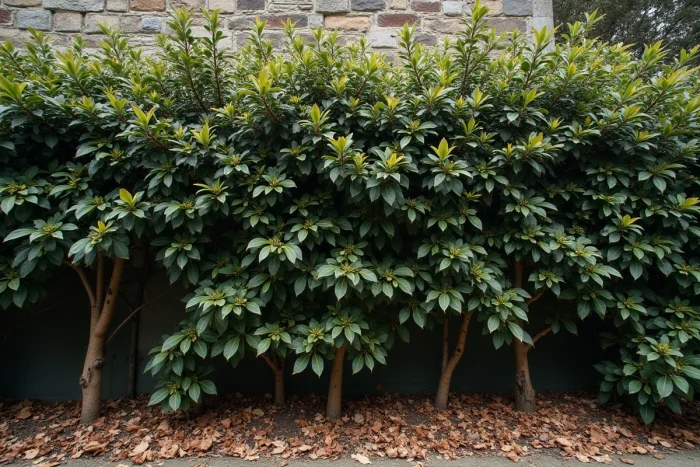
Scale insects form small white cottony clusters or brown shields attached to stems and the undersides of leaves. They feed on sap and gradually weaken the shrub. Like the psyllid, they produce honeydew, which often leads to the appearance of sooty mold in parallel.
Treatment relies on mechanical cleaning (soft brush, water jet) combined with sprays of white oil at the end of winter, before bud break. This oil coats the shields and suffocates the overwintering individuals. On a potted laurel, manually removing visible colonies accelerates the result.
Treating scale insects before spring prevents the new generation from settling. A late intervention, after the dispersal of mobile larvae, requires multiple applications without a guarantee of complete eradication.
Dry or yellow leaves of bay laurel: water stress or frost
Yellowing or drying of bay laurel leaves is not always pathological. Poorly drained soil causes excess root water that suffocates the underground system: the leaves turn yellow and then brown at the edges. Conversely, a potted laurel exposed to full urban sun without sufficient watering shows rapid drying of the most exposed leaves.
Frost is another common cause. Bay laurel tolerates moderate negative temperatures, but a late frost episode after an early vegetative restart (common in heat island contexts) burns young shoots. Affected leaves turn brown within a few days. Pruning the frozen parts and mulching the base before winter is sufficient in most cases.
Bay laurel remains a shrub that recovers well after an attack, provided that the diagnosis is made early. Observing the undersides of leaves once a month between March and October, adapting the monitoring schedule to the local context (urban or rural), and prioritizing mechanical prevention over chemical treatments: these three reflexes cover the vast majority of situations encountered in the garden.