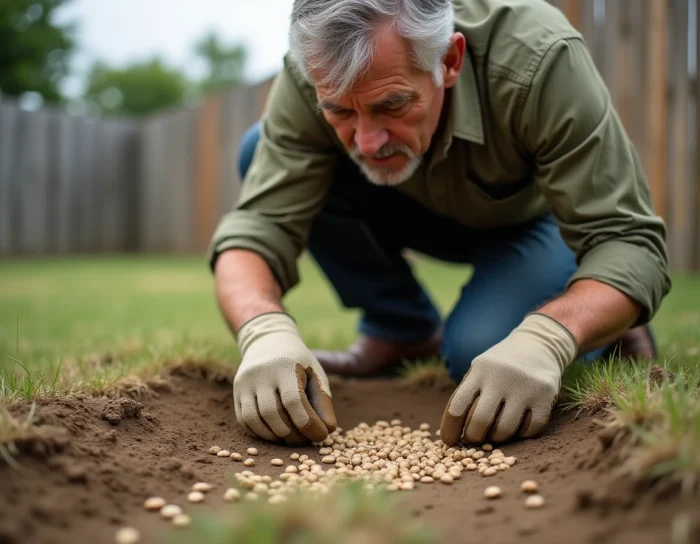
Why do your grass seeds remain on the surface after sowing?
After careful sowing, noticing that grass seeds remain visible on the soil surface is a common situation. The problem does not stem from a single cause, but from a chain of factors related to the soil, the sowing technique, and the immediate environment of the plot. Understanding these mechanisms allows you to take action before birds or the wind resolve the issue for you.
Soil Biological Activity and Natural Burial of Grass Seeds
Grass seeds have a small diameter, often less than two millimeters. In biologically active soil, microorganisms, earthworms, and mycorrhizal fungi contribute to creating fine porosity that facilitates the downward migration of seeds. The hyphae of mycorrhizae, by weaving a network between soil particles, generate micro-channels in which a light seed can gradually sink under the effect of rain or watering.
A soil sterilized by intensive herbicide use or depleted in organic matter loses this self-burial capacity. Feedback from urban landscapers confirms this observation: in the compacted clay soils of densely populated areas, the absence of biological life keeps the seeds on the surface. The National Union of Landscape Companies (UNEP) recommends systematic prior aeration to achieve significantly better natural burial.
Stimulating this biological activity before sowing, through the addition of mature compost or a mycorrhizal inoculant suitable for grasses, provides the seeds with a welcoming environment capable of integrating them without heavy mechanical intervention. To delve deeper into the reasons for this phenomenon, a detailed file on grass seeds on the surface on Agri Systems describes the mechanisms at play.
Soil Compaction: Why the Soil Rejects Seeds
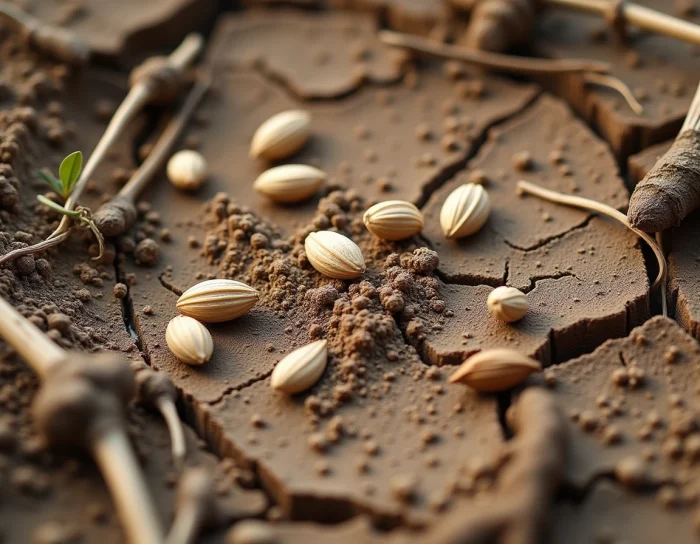
Compaction is the most underestimated mechanical factor. Soil compacted by foot traffic, the passage of machinery, or simply by years without soil work forms a crust that prevents any penetration. The seed rests on this hard surface like on a sidewalk.
A compacted soil does not retain seeds, even when abundantly watered. Water runs off instead of infiltrating, carrying the seeds to the low points of the terrain. This results in bare areas at the top of the slope and clusters of seeds in the depressions.
Identifying Compacted Soil Before Sowing
Two simple tests can verify the state of the ground:
- Insert a screwdriver into the moist soil: if you have to force it beyond the first few centimeters, compaction is real and requires scratching or using a scarifier.
- Observe the behavior of the watering water: if it forms puddles that persist for several minutes, drainage is insufficient to accommodate sowing.
- Examine the presence of earthworms by turning over a small clod: their absence indicates biologically poor soil that is structurally closed.
Scratching the top five centimeters, followed by light rolling after sowing, creates the necessary seed-soil contact for germination. Skipping this step explains the majority of failures observed in garden lawns.
Watering and Weather Conditions: The Role of Water in Seed Resurgence
Water is essential for germination, but excess water has the opposite effect. Overly powerful watering, with a direct jet, displaces the seeds and brings them back to the surface. Heavy rains after sowing cause the same phenomenon through splash effect: each drop hitting the bare soil projects soil particles and seeds.
Fine and frequent watering keeps the seeds in place much better than heavy watering spaced out. The goal is to keep the top two centimeters of soil constantly moist, without ever creating runoff.
Coated Seeds and Resistance to Leaching
In recent years, seed companies have developed seeds treated with hydrophobic coatings that resist leaching better during the first rains. The technical report from Barenbrug on innovations in grass seeds for 2025 confirms a growing adoption of these coated varieties, which significantly reduce surface resurgence. These coatings slightly weigh down the seed and alter its interaction with water, promoting its anchoring in the soil.
However, the European Union strengthened REACH standards for topsoil in 2025, banning certain synthetic polymers that created excessive hydrophobicity in the soil. If you use a cover soil after sowing, check its compliance with the new requirements to avoid a paradoxical effect where the substrate itself repels water and seeds.
Sowing Depth and Soil Coverage: The Technical Gesture That Changes Everything
A grass seed germinates properly when buried between two and five millimeters below the surface. Deeper, it lacks light to sprout. On the surface, it dries out between waterings or becomes an easy target for birds.
Covering with a fine topsoil remains the most reliable method to keep the seeds at the right level. A regular, barely visible layer is sufficient. An excess of topsoil suffocates the seed just as much as a bare sowing leaves it exposed.
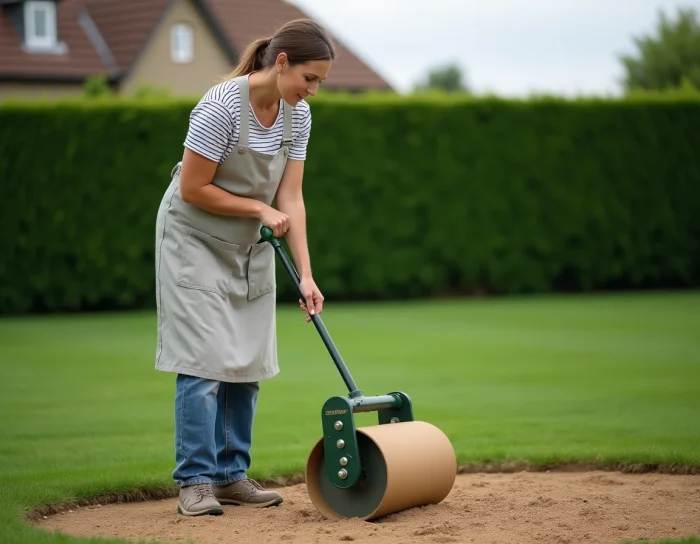
Rolling after sowing, often overlooked, plays a direct role. It presses the seed against the soil, increases contact with soil moisture, and reduces wind catch. On freshly scratched and then rolled terrain, the proportion of seeds remaining on the surface decreases significantly compared to a sowing simply scattered by hand.
- Scratch the soil for a few centimeters to break the surface crust.
- Sow by crossing passes (once in one direction, once perpendicularly) to ensure even distribution.
- Cover with a thin layer of sifted topsoil or sand mixed with compost.
- Roll with a lawn roller or, if not available, compact with a board on small areas.
The timing also matters. Sowing done in strong winds disperses the seeds unevenly and concentrates them in sheltered areas. Waiting for a calm day, late in the afternoon, limits evaporation and gives the seeds their best chance to stay where they were deposited.
Grass germination generally takes one to three weeks depending on the species and soil temperature. During this period, maintaining constant moisture without moving the seeds is the balance to find. A light mulch, such as a forcing cover, temporarily protects the most exposed areas from wind and birds while allowing the necessary light for sprouting to pass through.