Who Can Drive a Quad with a B License in France: Rules and Conditions to Know
The B license allows for the driving of cars, but its scope also covers certain motorized quadricycles. Knowing which ones, and under what conditions, requires distinguishing between two regulatory categories with very different technical thresholds. Light quadricycle or heavy quadricycle, road-approved or not: each combination modifies the required license, the insurance obligation, and the required equipment.
Categories L6e and L7e: the table of technical thresholds that determines the license
French regulations classify road-approved quads into two European categories. The necessary license directly depends on the vehicle’s category, not the commercial model.
| Criterion | Light quadricycle (L6e) | Heavy quadricycle (L7e) |
|---|---|---|
| Maximum engine capacity (thermal) | 50 cm³ | Greater than 50 cm³ |
| Maximum speed | 45 km/h | Not limited to 45 km/h |
| Maximum power | 4 kW (thermal engine) / 6 kW (electric) | 15 kW |
| Maximum unladen weight | 425 kg | 450 kg (passenger transport) / 600 kg (goods transport) |
| Minimum required license | AM (from 14 years) or any higher license | B1 (from 16 years) or B license |
| Minimum age | 14 years | 16 years |
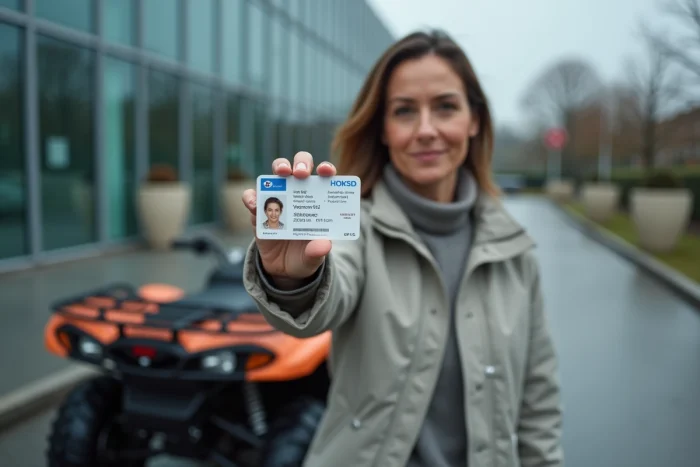
A holder of the B license can therefore drive a quad with a B license in both categories, since the B license encompasses the AM and B1 categories. On the other hand, a driver who only possesses the AM license is limited to light quadricycles.
Road-approved quad and non-approved quad: the distinction that changes everything
Having the right license is not enough. The quad itself must be approved for use on public roads. A quad sold as a recreational vehicle, intended for private grounds or circuits, does not have CE/UTAC approval. Without this approval, road circulation remains prohibited, regardless of the driver’s license.
The DGCCRF reported, in an update on March 28, 2024, an increase in inspections and penalties targeting non-approved quads circulating on public roads. The cumulative conditions for driving a quad on the road are strict:
- The vehicle must have a CE or UTAC approval and be registered (valid registration document).
- A specific civil liability insurance for the quad is mandatory, even for a light quadricycle.
- Complete road equipment must be present: lighting, turn signals, mirrors, license plate.
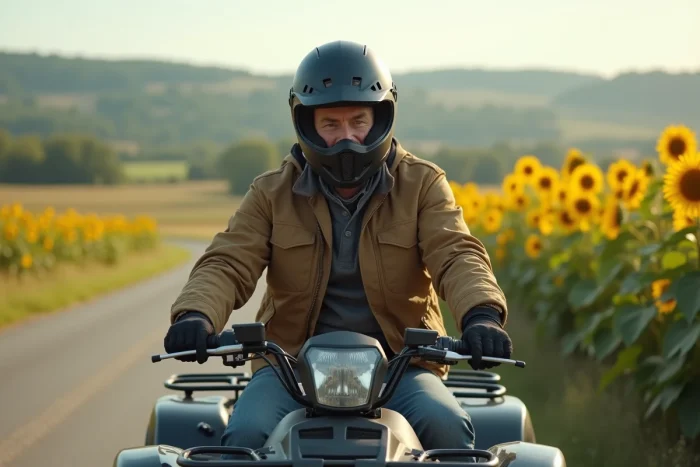
- The driver must wear an approved helmet and CE-certified gloves.
A recreational quad used on private land is exempt from these obligations. But as soon as it takes a communal path or a departmental road, it falls under the scope of the Highway Code.
Penalties for non-compliance
Driving a non-approved quad on the road exposes one to vehicle confiscation and a fine. The lack of insurance constitutes a separate offense, punishable by criminal penalties. A valid B license does not protect if the quad itself is outside regulatory compliance.
Technical inspection of quads: what the 2023 decree provides
Decree No. 2023-974 of October 23, 2023, incorporates motorized quadricycles (categories L6e and L7e) into the future technical inspection system for two or three-wheeled vehicles and quadricycles. The Council of State has confirmed the validity of this text.
Road-approved quads will be subject to periodic technical inspection, a requirement that did not previously exist for these vehicles. For a holder of the B license using a heavy L7e quad on the road, this means an additional constraint: maintaining the vehicle in a compliant state, under penalty of refusal during the inspection.
This measure targets already registered quads and those that will be registered in the future. Non-approved recreational quads used exclusively on private land are not affected by this system.
Conditions imposed by quad rental companies: stricter than the law
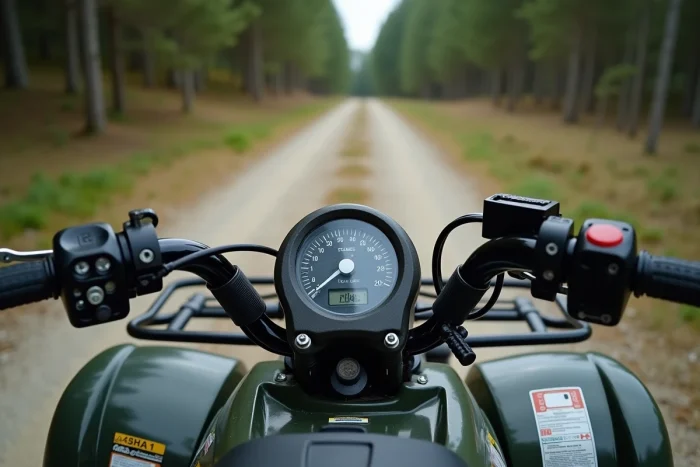
The legal framework sets a minimum, but quad rental and touring professionals often apply higher requirements. A minimum of two years of B license seniority is a common condition among rental companies. Young drivers in their probationary period are sometimes denied access to heavy quads.
A mandatory safety briefing before each outing has become the norm, particularly due to the specific behavior of the quad (high center of gravity, risk of overturning). These restrictions do not stem from the Highway Code but from the general conditions of the service providers and their insurers.
B license and quad power: a gap to be aware of
The B license does not limit the power of the L7e quad that its holder can drive, as long as the vehicle remains within the regulatory category (maximum 15 kW). Conversely, some models exceed this threshold and fall outside the L7e classification. They then fall under another category and may require a different license.
Checking the registration document of the quad and its L category remains the most reliable reflex before any purchase or rental. The category listed on the registration document determines the required license, not the engine capacity stated by the manufacturer or the seller’s claims.
The regulatory framework for quads in France is based on two distinct pillars: the vehicle’s category (L6e or L7e) and its road approval. The B license covers both categories, but without a registration document, without insurance, and without compliant equipment, this license is not sufficient to make circulation legal. With the scheduled introduction of technical inspections for quadricycles, vehicle compliance will become an additional verification point for all drivers.