Lacoste’s Main Competitors: Analysis and Strategies to Stand Out
Lacoste occupies a unique space in global fashion: that of premium sportswear with a French heritage. Founded in 1933 by René Lacoste, the crocodile brand has navigated through the decades by relying on its tennis roots and its iconic polo. However, the competitive landscape has changed dramatically in recent years, and Lacoste’s rivals are no longer the same as they were ten years ago.
Lacoste’s Upmarket Shift and Repositioning Against Premium Brands
The recent strategic shift of Lacoste deserves examination even before discussing its competitors. In 2023, the brand announced its intention to reduce promotions and strengthen its premium positioning. This concretely translates to an increase in average prices, collaborations with designers, and more selective distribution.
This repositioning alters the competitive analysis. Lacoste is no longer directly competing against Nike or Adidas in the mass sportswear arena. The brand aims to align itself more closely with Ralph Lauren and Tommy Hilfiger, two players in the premium lifestyle sector that share a similar DNA: sports heritage, classic dress codes, and international ambition. To understand Lacoste’s competition according to Mlle E, one must first grasp this category shift.
On the other hand, this upmarket shift creates a gap. The segment of “accessible and stylish polos” that Lacoste historically occupied becomes open territory for brands like Fred Perry or even more generalist labels that are improving in perceived quality.
Direct Competitors of Lacoste: Ralph Lauren, Tommy Hilfiger, Fred Perry
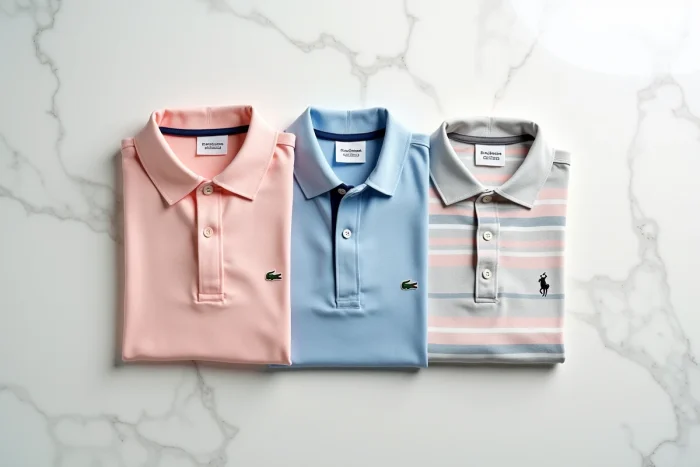
Ralph Lauren is the most significant competitor for Lacoste. Both brands share a similar promise: an elegant lifestyle rooted in sport (tennis for Lacoste, equestrian polo for Ralph Lauren). The difference lies in the depth of their ranges. Ralph Lauren covers a very broad spectrum, from the high-end Purple Label to more accessible lines, giving it a commercial flexibility that Lacoste lacks.
Tommy Hilfiger operates in a slightly different register. The American brand leans more towards pop culture and collaborations with mainstream celebrities. Its image is younger and more urban. In terms of products, there is real overlap with Lacoste (polos, lightweight jackets, sneakers), but Tommy Hilfiger targets a consumer less attached to sports heritage.
Fred Perry occupies a more niche position. Emerging from British mod culture and tennis, the brand shares with Lacoste a sporty DNA and an iconic product (the laurel crown polo). Its price positioning is comparable, but its clientele is more rooted in musical and streetwear subcultures.
Nike and Adidas: Indirect but Burdensome Competitors
These two giants do not target the same segment, but they capture an increasing share of consumers’ clothing budgets. When Nike launches a premium lifestyle line or Adidas collaborates with a fashion designer, these products directly compete with Lacoste’s casual pieces.
The polo category remains the main battleground. Lacoste holds a strong symbolic advantage here (the crocodile is almost synonymous with the garment itself), but alternatives are multiplying, including from fast-fashion brands offering polos at a fraction of the price.
Competition in Asia: A Landscape Often Overlooked by Europe
Available competitive analyses online remain largely focused on Europe and North America. The market reality tells a different story. China has been one of the fastest-growing markets for Lacoste since the post-Covid period, with an intensive retail and digital strategy (opening stores, strengthening presence on platforms like Tmall and Douyin).
In this arena, Lacoste faces competitors very different from those it encounters in Paris or New York:
- Li-Ning, a Chinese sportswear brand that is moving upscale and increasing its presence at Paris Fashion Week, blurring the lines between sport and fashion
- Anta, a Chinese giant that has acquired Western brands (including Fila for the Asia region) and has a massive distribution network
- Bosideng, a specialist in technical clothing that is repositioning itself in the premium lifestyle sector with prices comparable to those of Lacoste
Competitive analysis must be regionalized, not globalized. A marginal competitor in France can be the number one rival in Southeast Asia.

Communication Strategy and Visual Identity: What Distinguishes Lacoste
The crocodile remains one of the most recognized logos in the world. This visual identity gives Lacoste an advantage that its competitors struggle to replicate: instant product identification without the need for text. Ralph Lauren has a comparable asset with its polo player, but few other brands in the segment can say the same.
In terms of campaigns, Lacoste has made a distinctive choice in recent years. The brand focuses on its tennis heritage while embedding it in broader cultural narratives. The partnership with Novak Djokovic, in what the brand calls its “GOAT Era,” illustrates this approach: associating top athletic performance with premium lifestyle.
Creative Collaborations and Influencers
Lacoste regularly engages in collaborations (the brand aimed for two to three per year according to its executives). These partnerships are not so much about generating revenue as they are about renewing the brand’s perception among younger audiences. Collaborations bring what the brand cannot create on its own, according to terms used internally at Lacoste North America.
However, the available data does not allow for precise measurement of the impact of these collaborations on sales or market share compared to competitors. Some collaborations generate strong media buzz without lasting commercial translation, while others find a foothold in stores.
Differentiation Levers Against Lacoste’s Competitors
Three axes emerge for the brand:
- Selective distribution, by reducing presence in discount channels to protect the premium image and justify the price level
- Authentic sports anchoring, which brands like Tommy Hilfiger or Hugo Boss cannot claim with the same historical legitimacy
- Regionalized digital strategy, with content and ambassadors tailored to each market rather than uniform communication
The Lacoste polo remains the anchor product of the entire strategy. As long as this garment retains its status as a fashion-sport icon, the brand has a foundation that its competitors can only circumvent, not attack head-on. The polo category itself is facing increasing pressure from more casual dress codes, and it is this evolution of usage, more than an isolated competitor, that represents the main challenge for Lacoste.